|
Home

   
|
|

Our
Customizable Formal Design Process
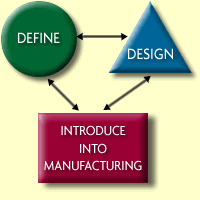 The
best product development projects tend to be organized in
more formal ways, each basically the same, while unique to a
particular situation. The process outlined below describes
the outline for this process, from which we extract the best
set of steps to proceed on a specific project. The
best product development projects tend to be organized in
more formal ways, each basically the same, while unique to a
particular situation. The process outlined below describes
the outline for this process, from which we extract the best
set of steps to proceed on a specific project.
Definition
Phase
- Define
Product Before Starting - Know what you will get as a
result
- Create a
Detailed Specification - Have an in depth knowledge of
the Functional Operation of the proposed
product
- Create Block
Diagram - Solidify the Design Solution and make it
real, while changes costs the least.
- Create
Project Plan - Know when you will be getting what
during the project and how the costs will be
incurred
- Staff the
Project with the Required Skills - Know who will be
doing what in critical areas
- Blend
Internal Skills with Outside ones - Minimize your
project learning curve, while getting the specific
skills you really need.
- Select from a
quality set of outside resources - Minimize your
design risk on your project.
- Participate
in the staffing process (optional) - Have confidence
in the abilities of outside participants
Design
Phase
- Generate the
Required Design to the Project Plan - Know how the
project is progressing compared to the Project
Plan
- Create
breadboards of high risk components (if applicable) -
Minimize your design risk before expending large
dollars on design.
- Create the
Design in a high quality environment - Benefit from
the knowledge and experience of many previous quality
designs.
- Design and
Cost Reviews at Periodic Points - Know what is going
on during this critical phase.
- Generate the
Production Prototype - Know what exactly is being
created and how this compares to the plan.
- Participate
in Vendor Selection (optional) - Know who will be
potential resources for production.
- Design and
Cost Reviews at Periodic Points - Fab and Assembly
Process - Receive details of progress to milestones
and cost, plus know production problem risk areas.
- Perform Debug
and Test - See the real product come alive.
- Observe the
Integration, Debug and Test Process (optional) -
Assess first hand what is going on.
- Design
Verification Plan and Testing - Know that the product
meets all of its critical design
parameters.
- Design and
Cost Reviews at Periodic Points - Receive detailed
technical and cost status reports to the compared to
the plan so you can keep control of time and cost.
- Formal
Product Demonstration - See the final product
actually working to its target functions.
- Generate
Final Production Documentation - Receive all of the
required documentation, completely updated and ready for
production.
- Generate
Production Release Plan - You know what is going to be
delivered and when
- Design and
Cost Reviews at Periodic Points - You receive detailed
technical and cost status reports at this critical
point.
- Work with
your Internal Production Engineering Process - You
know that the results will be usable in your
manufacturing processes.
Introduce
Into Manufacturing Phase
- Release to
Manufacturing - Have a detailed and final review of
all documentation generated for the release. Know that
the documentation meets your production requirements.
- Manufacturing
Sustaining - Receive help with engineering problems
that occur during the production ramp up phase.
 FREE
and Discounted "Stump the Expert" Consulting Services --
> Click
here FREE
and Discounted "Stump the Expert" Consulting Services --
> Click
here
|


